
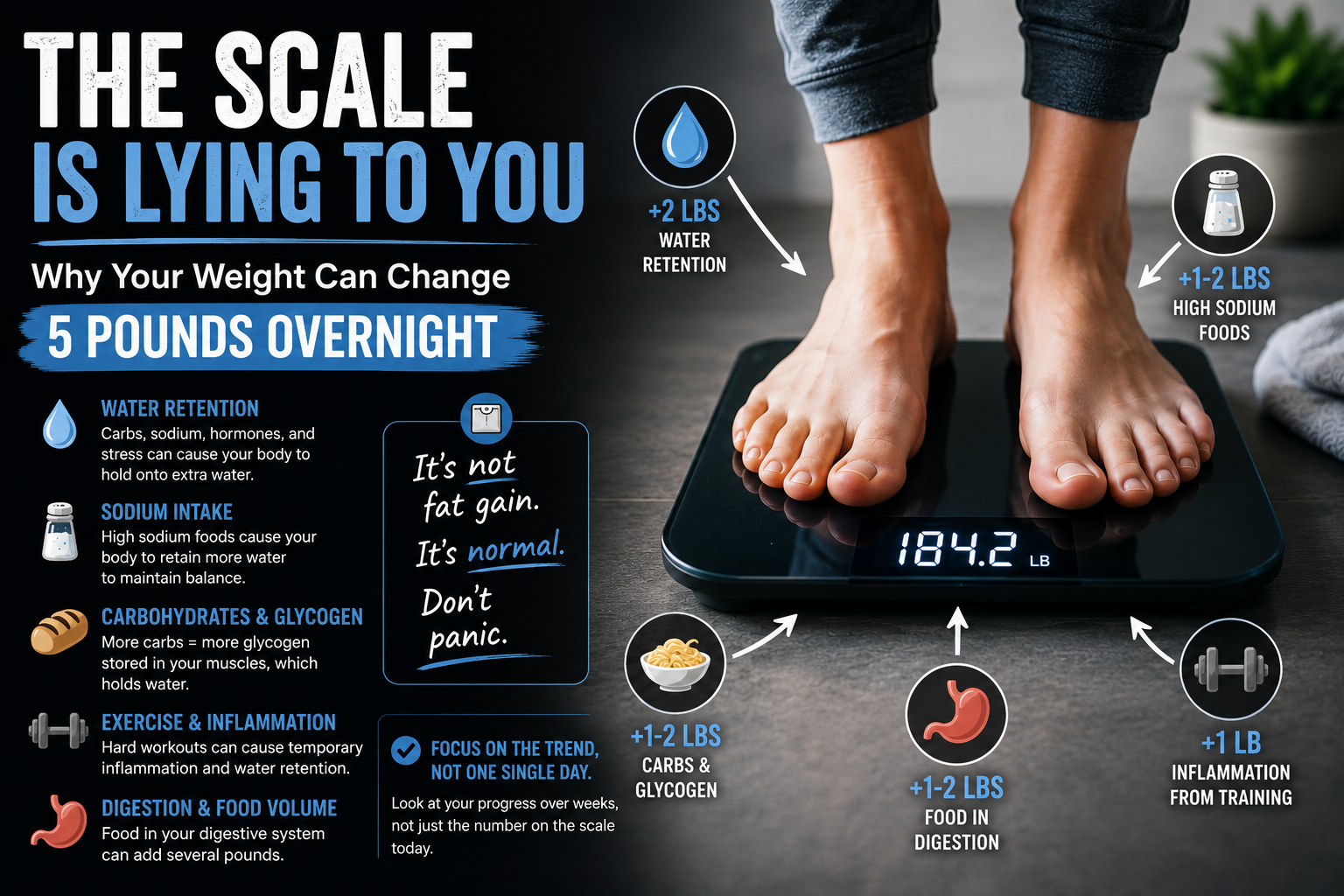
You wake up, step on the scale, and somehow you're four pounds heavier than yesterday.
Your first thought is probably:
"What did I do wrong?"
Maybe you had pizza with friends.
Maybe you stuck to your diet perfectly.
Maybe you even worked out.
Regardless, the number staring back at you feels like proof that you've failed.
Here's the good news:
You almost certainly didn't gain four pounds of body fat overnight.
In fact, it's nearly impossible.
What the Scale Is Actually Measuring
Most people think the scale only measures fat.
It doesn't.
The number you see is your total body weight at that moment.
That includes:
- Body fat
- Muscle
- Water
- Glycogen (stored carbohydrates)
- Food that's still being digested
- Waste that hasn't left your body yet
Body fat is just one piece of the puzzle.
That's why your weight can change dramatically even when your body fat hasn't changed at all.
Could You Really Gain Five Pounds of Fat Overnight?
Let's do the math.
One pound of body fat stores roughly 3,500 calories.
To gain five pounds of fat in a single day, you'd need a calorie surplus of about 17,500 calories.
Not 17,500 calories eaten.
A 17,500-calorie surplus after accounting for everything your body burns.
For most people, that's incredibly unlikely.
So if the scale jumps several pounds after one meal or one weekend, fat probably isn't the explanation.
Water Is Usually the Biggest Reason
Water is responsible for many of the dramatic changes people see on the scale.
A few common reasons include:
Eating More Carbohydrates
Carbohydrates are stored in your muscles and liver as glycogen.
For every gram of glycogen your body stores, it also stores several grams of water.
If you've been eating fewer carbs and then enjoy a big pasta dinner or a couple slices of pizza, it's completely normal for your weight to increase the next morning.
That doesn't mean you suddenly gained fat.
It often means you're carrying more glycogen and more water.
Sodium
Ever notice your weight goes up after eating restaurant food?
It's not just the calories.
Many restaurant meals contain much more sodium than you normally eat.
Extra sodium can cause your body to hold onto more water for a day or two.
Once things return to normal, so does your weight.
Food Volume
The scale can't tell the difference between body fat and food that's still in your digestive system.
If you eat a large dinner, some of that weight is literally the food itself.
It hasn't disappeared by the next morning.
Exercise Can Increase Your Weight Too
This surprises a lot of people.
A hard workout can actually make the scale go up temporarily.
When you lift weights or perform challenging exercise, your muscles experience tiny amounts of damage.
As part of the recovery process, your body holds onto additional water.
It's completely normal.
Many people panic after starting a new workout routine because the scale doesn't immediately go down.
Sometimes it goes up first.
That doesn't mean the workout isn't working.
Why Daily Weigh-Ins Can Be Misleading
There's nothing wrong with weighing yourself every day.
In fact, daily weigh-ins can be useful.
The mistake is assuming every number means something.
Imagine these weights over one week:
- Monday: 185.4 lbs
- Tuesday: 186.8 lbs
- Wednesday: 185.9 lbs
- Thursday: 184.7 lbs
- Friday: 185.5 lbs
- Saturday: 184.9 lbs
- Sunday: 184.3 lbs
If you only looked at Tuesday, you'd think you were gaining weight.
But looking at the entire week tells a completely different story.
The trend is what matters.
Not one random number.
How to Get More Consistent Weigh-Ins
If you're going to track your weight, try to make the conditions as similar as possible.
A few simple habits can help:
- Weigh yourself at the same time each day.
- Use the same scale.
- Weigh yourself before eating or drinking.
- Wear similar clothing, or none at all.
- Focus on weekly averages instead of daily changes.
This won't eliminate fluctuations, but it will make the overall trend easier to see.
Don't Let One Number Change Your Plan
One of the biggest mistakes people make is reacting to every weigh-in.
The scale goes up two pounds.
They slash calories.
Add more cardio.
Skip meals.
Then two days later their weight drops right back down because the extra water disappeared.
Nothing actually needed fixing.
Consistency almost always beats constant adjustments.
The Bottom Line
Your body weight is supposed to fluctuate.
Water, carbohydrates, sodium, digestion, exercise, and even stress can all change the number you see on the scale from one day to the next.
That doesn't mean you're gaining fat.
And it definitely doesn't mean your diet isn't working.
The next time the scale jumps a few pounds overnight, don't panic.
Take a breath.
Look at the trend over the next week instead of one single weigh-in.
Because the scale is measuring much more than body fat, and understanding that can save you from making decisions you'll probably regret.