
If you've ever tried to lose weight, you've probably had this thought at some point.
"I don't understand."
"I stopped eating fast food."
"I've been making healthier choices."
"I've been eating salads almost every day."
"So why isn't the scale moving?"
It's frustrating because you're doing something that's objectively better for your health.
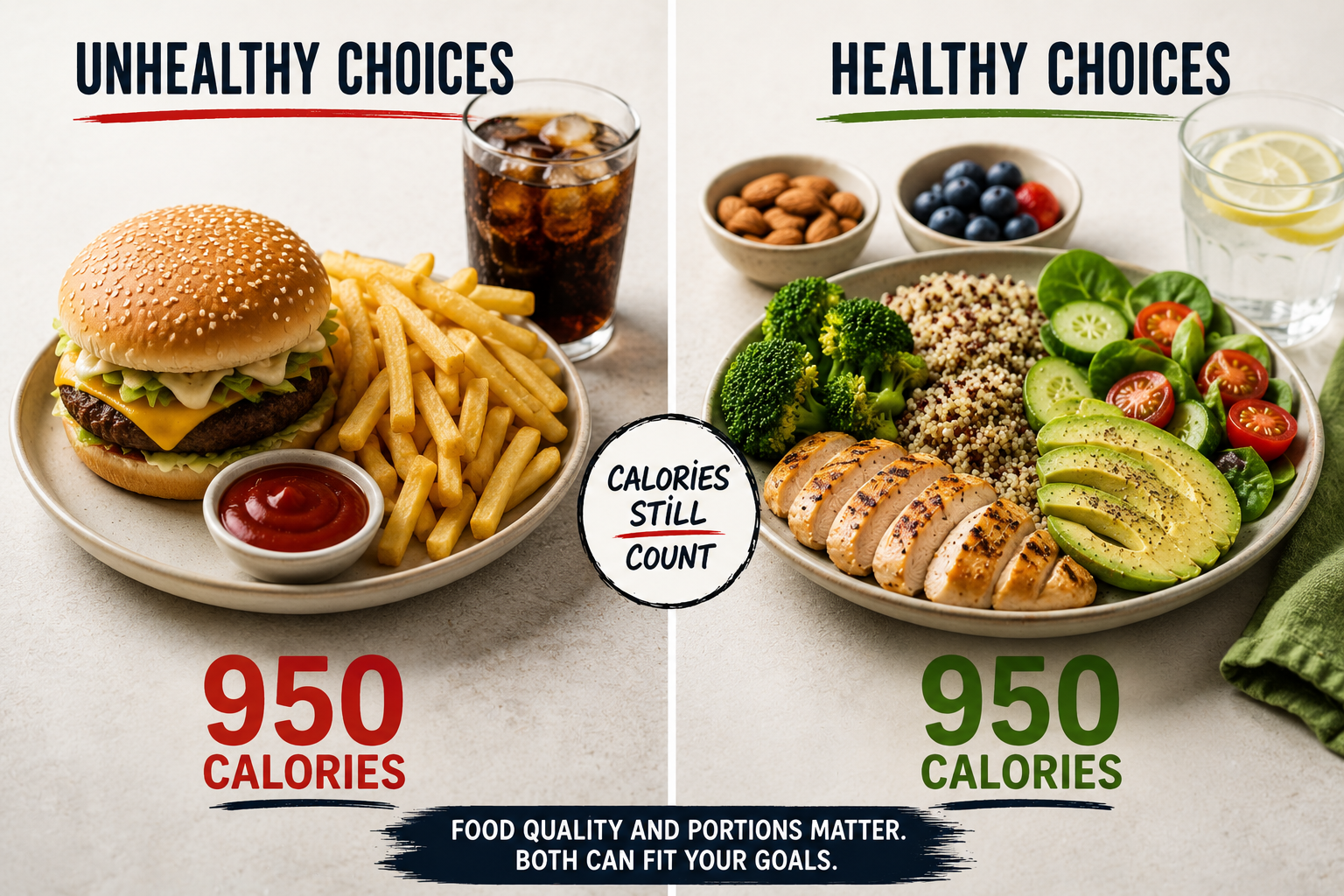
The problem is that healthy and low-calorie aren't always the same thing.
You can improve the quality of your diet and still eat more calories than your body needs.
Healthy Doesn't Necessarily Mean Low-Calorie
One of the biggest misconceptions about nutrition is that once a food is considered healthy, calories no longer matter.
Unfortunately, that's not how it works.
Many incredibly nutritious foods are also surprisingly calorie-dense.
That doesn't make them bad.
It just means they still contribute to your daily calorie intake.
Nuts
Nuts are packed with healthy fats, fiber, vitamins, and minerals.
They're also one of the easiest foods to overeat.
A small handful makes a great snack.
A few handfuls while watching TV can easily become several hundred calories without you even noticing.
Peanut Butter
Peanut butter has earned its healthy reputation, and for good reason.
It contains healthy fats, some protein, and it's incredibly satisfying.
The problem is portion size.
Most people don't actually measure two tablespoons.
They scoop.
What looks like one serving is often two or three.
Olive Oil
Olive oil is one of the healthiest fats you can include in your diet.
It's a staple of the Mediterranean diet and offers plenty of nutritional benefits.
It's also very calorie-dense.
A generous pour into a frying pan or over a salad can add a few hundred calories without making the meal look much different.
Avocados
Avocados are another excellent example.
They're loaded with healthy fats, fiber, and important nutrients.
They're also much higher in calories than many people expect.
There's no reason to avoid them if you're trying to lose weight, you just want to be mindful of portion sizes.
Rice, Quinoa, and Other Whole Grains
Whole grains often get left out of conversations about calorie intake.
Foods like brown rice, quinoa, oats, and whole wheat pasta are nutritious sources of carbohydrates and can absolutely be part of a healthy diet.
But they're still a source of calories.
Ever serve yourself rice without measuring it?
Most of us have.
What feels like one serving often ends up being much more, especially when you're eating from a large bowl or grabbing a side at a restaurant.
These foods aren't the problem.
They just deserve the same awareness as everything else on your plate.
Smoothies
Smoothies are another great example of how healthy foods can become surprisingly calorie-dense.
Fruit, yogurt, peanut butter, oats, seeds, and honey are all nutritious ingredients.
Throw several of them into a blender and you've suddenly got a smoothie with 600-800 calories.
There's nothing wrong with that if it fits your goals.
The problem is that many people don't realize they're drinking the equivalent of a full meal.
On top of that, liquids usually aren't as filling as solid food.
It's much easier to drink 700 calories than it is to eat them.
Healthy Foods Are Still Worth Eating
At this point you might be wondering if it's even worth going out of your way to eat healthier.
Absolutely.
This isn't an argument against eating nuts, avocados, quinoa, or olive oil.
Quite the opposite.
These foods provide nutrients your body needs and often keep you fuller than highly processed alternatives.
The goal isn't to remove them.
The goal is simply understanding how they fit into your overall diet.
Healthy Foods Still Count
One of the easiest ways to accidentally stop losing weight is by assuming healthy foods somehow don't count.
They do.
Whether your calories come from pizza or almonds, they still contribute to your daily energy intake.
That doesn't mean all foods are equal.
A diet built around lean protein, fruits, vegetables, whole grains, and healthy fats is generally much better for your overall health than one built around highly processed foods.
But if your goal is losing weight, total calorie intake still plays an important role.
Why Healthy Foods Can Actually Make Dieting Easier
Here's the interesting part.
Healthy foods often make dieting easier, not harder.
A meal with lean protein, vegetables, fruit, and whole grains is usually much more filling than a meal built around highly processed snacks.
When you're fuller, you're less likely to keep reaching for more food an hour later.
That's one reason people who focus on food quality often find it easier to stay in a calorie deficit without constantly feeling hungry.
What Should You Do?
You don't need to eliminate any of these foods.
You don't need to obsess over every calorie either.
Instead, spend a little time learning the calorie content of the foods you eat most often.
You'll quickly develop a better sense of portion sizes, and making informed decisions becomes much easier.
You don't have to be perfect.
You just need enough awareness to understand where your calories are coming from.
The Bottom Line
Eating nutritious foods is one of the best things you can do for your overall health.
But healthy eating alone doesn't guarantee weight loss.
Nutritious foods still contain calories, and those calories still matter if your goal is changing your body weight.
The goal isn't to choose between eating healthy and paying attention to calories.
The goal is to understand that both matter.
Fill your plate with foods that support your health, keep you full, and that you actually enjoy eating.
Just remember that even the healthiest foods still contribute to your daily calorie intake.
Once you understand that, weight loss becomes a whole lot less confusing.